


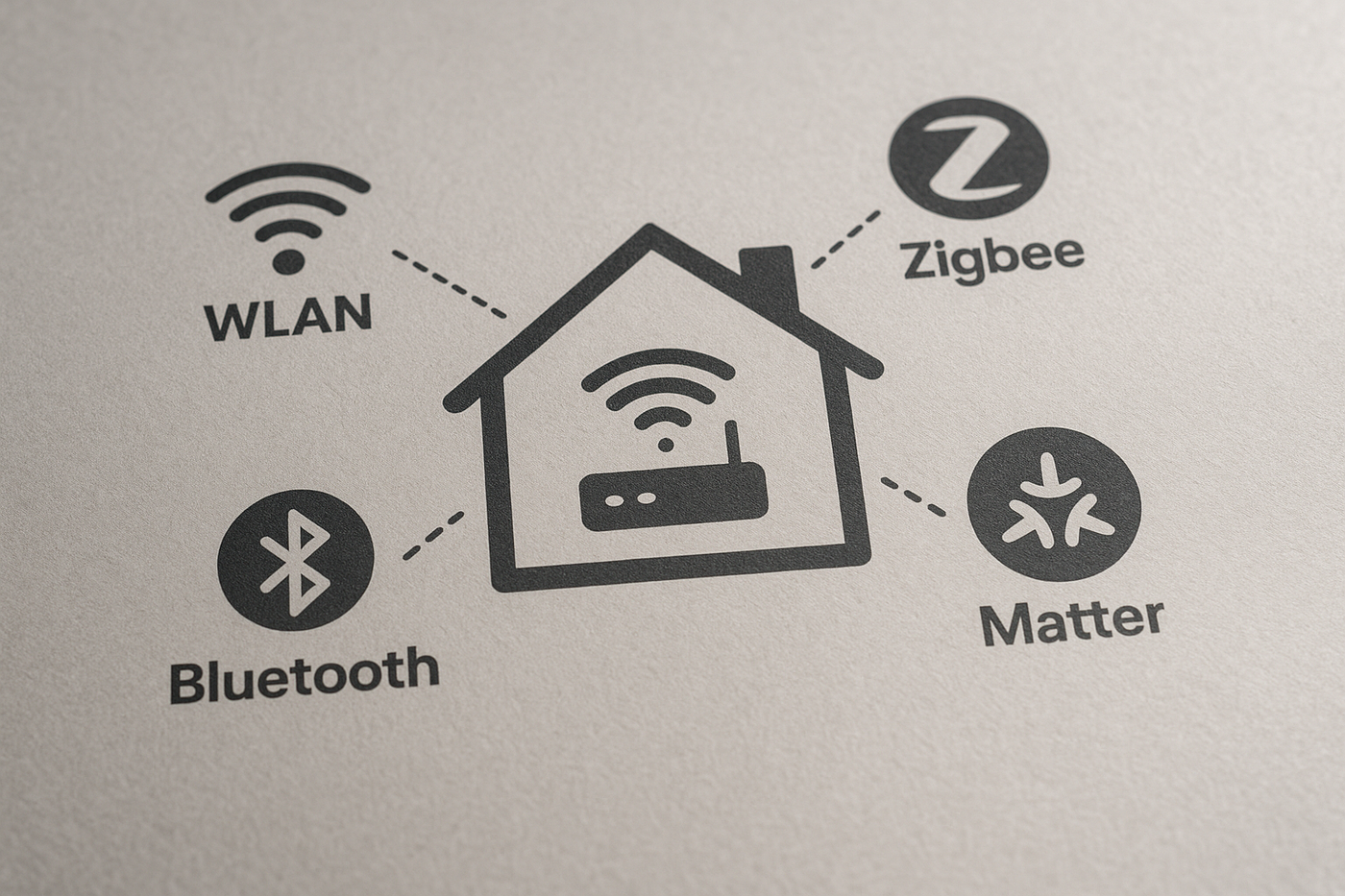


Wi-Fi in the Smart Home
Wi-Fi is the most widely used wireless standard in smart homes and forms the basis for most of our devices. Since almost every household already has a Wi-Fi network, smart devices can be easily integrated and controlled directly via the "Smart Life" app—without the need for an additional hub or gateway.
One major advantage of Wi-Fi is its long range and high speed, which enable a stable connection and fast response times. In addition, devices can be controlled worldwide via the cloud, so you can access your smart home anytime, even when you're away. Installation is also particularly easy, as the existing Wi-Fi network is all that's needed.
One minor disadvantage is that many Wi-Fi devices can increase the load on the network. If you have a large number of connected devices, it is therefore a good idea to consider additional routers or repeaters to ensure consistently good performance.
Wi-Fi devices by Siro
View all-

 8% off
-

 20% off
-


-


-


-

 14% off
-


-


-


-


-

 New arrival
-

 8% off
-

-

 16% off
SIRO
Smart Wi-Fi Surface-Mounted Wall Thermostat 5-Pack Value Set
€239,00€284,50Unit price /Unavailable


ZigBee in the Smart Home
ZigBee is an energy-efficient wireless standard specifically designed for smart home devices. It enables the interconnection of many components via a so-called mesh network: Every ZigBee device can relay signals, so the range continuously increases throughout the entire house. This makes ZigBee particularly suitable for larger installations with many devices.
A major advantage is the low power consumption – many ZigBee sensors run for years on a single battery. In addition, the connection is very stable, as the mesh network adapts automatically and reroutes failures through other paths.
As a minor disadvantage, a ZigBee gateway is generally required for operation, which acts as the control center.
ZigBee Devices by Siro
View all-


-

 28% off
-

 20% off
-

 16% off
-

 8% off
-

 13% off
-

 6% off
SIRO
Smart AllProtect Duo2 – Complete protection with motion, water, smoke, and climate sensors
€109,00€115,37Unit price /Unavailable -

 11% off
-


-

 16% off
-

 18% off
SIRO
Smart Radiator Thermostat 6-Piece Starter Set Open-Window Automation
In stock€249,90€303,70Unit price /Unavailable -

 13% off
-


-

 New arrival
-

 New arrival
-

 23% off
SIRO
Smart Door and Window Contact 4-Pack Bundle incl. Smart Hub
In stock€72,90€94,50Unit price /Unavailable -

 New arrival
-


-

 11% off


Bluetooth in the Smart Home
Bluetooth is primarily known for direct communication between devices over short distances. In the smart home, it is particularly suitable for smart locks or control devices that you can conveniently operate via smartphone. The advantages are quick pairing, a stable direct connection, and low power consumption.
Thanks to the widespread use of Bluetooth in smartphones, no additional hardware is required—you simply control your devices directly. Setup is also usually very straightforward.
One disadvantage is its relatively limited range. For larger apartments or houses, Bluetooth is therefore often only practical in combination with other wireless standards.
Bluetooth devices by Siro
View all-

 10% off
-

 Up to 9% off
-


-


-
20% off
-
-
-

 14% off
-
-

 20% off
-

 20% off
-


-
-
-


-


-

 9% off
SIRO
Electronic Door Lock with Fingerprint Recognition | Keyless Access System
In stock€109,00€119,90Unit price /Unavailable -


-
-


